

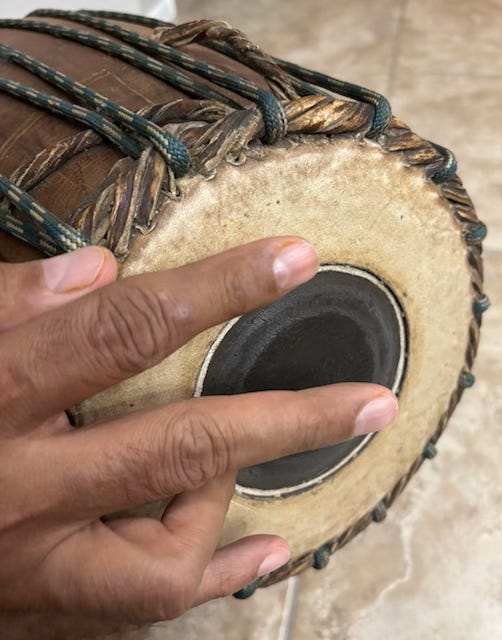
Listen to the author reading this story:
When you call, I struggle to rein in my runaway pulse because we’ve had no contact for thirty years, because it’s been decades since I stopped singing, because you and I grew up with Carnatic classical music, because my voice and your instrument, the mridangam, were inseparable and because you featured, prominently, in my long-gone era.
My question leaps. “You mean you’re in Austin, Avi? ”
You answer that you’re here for a performance. “Can I visit you?” you ask.
“Vaa! Vaa, I’ll make lunch,” I say, notice how quickly I’ve lapsed into Tamil, our familiarity.
During the next hour, I make sambar and vendaka curry—haven’t forgotten okra’s your favorite―and realize I should have mentioned my husband, Shyam, told you he’s in Houston for work.
Until you take an Uber and arrive with a box of Mysorepak from Adyar Sweets―a treat I haven’t tasted in decades because Shyam won’t eat it―I wait at the door and obsess, hug-aa, no hug-aa?
You give me an awkward, oru-second embrace, your stubble grazing my cheek. I hadn’t anticipated the time stamps: you’re older, some weight gain, nereya gray hair.
You ask, “Yenna? Do you practice?”
I fake-laugh. “Haven’t sung for a l-o-o-n-g time, da. All gone.”
“That is anyayam,” you say. Unlawful. Tragic. “Before, you were our star.”
I notice the pull in my belly.
Before.
My Appa drove me in his Maruti to music class three times a week. Before, I received awards: at ten, fifteen, eighteen. Before, I was a radio-television artist. Before, concert-kutcheri audiences shouted, “Besh! One more!” Before, you accompanied me on your mridangam. Before, Appa called you, “That drummer,” derisively. Before, Appa saw me riding on your Bajaj scooter. Before, he noticed us sharing a plate of bonda purchased from a street vendor. Before, he brought Shyam home. Before, he chose to forget my musical training. Before, he squashed my protests and said, “With Shyam, you’ll have financial security and a happily-ever-after marriage.”
After.
Married, I arrived in Austin, suitcase brimming with music books, accouterments like shruti boxes, and kilos of advice from Amma and women relatives. After, I weighed their guidance: “Keep your house clean, cook nella-nella dishes, always be well dressed, become his right hand. No sandai, no arguments. And, chumma-chumma don’t complain, okay-a?” After, I understood that their instructions didn’t match the suitcase contents. After, Shyam said, “Don’t sing so loud, don’t disturb the neighbors,” and scoffed, “There’s no money in your music,” insisting, “Where’s the audience for Carnatic music here? It’s a big waste.” After, Shyam borrowed money to grow his venture. After, I took computer classes in college. After, I worked in his business. After, came children who taught me to be in the now.
Now.
You’re here, Avi, in my home and my imagination gets unleashed. I imagine we’d fled, pursued music together. I imagine you’ve placed your arm around me. I imagine holding your callused hands.
You want to know, “Why did you stop singing?”
I click my tongue as if your question’s not significant, say, “No time, da.”
You persist, “Tcha! You just let it go?” salt-pepper eyebrows knitting together.
I shrug, say, “Shyam has no interest in music,” ignore the gali sensation squeezing my abdomen, consider―the meaning of all this, because everything must have meaning, right?—your words, us eating, me making you sambar and okra, you crunching on the pappadam, your loyalty to your mridangam and I want to ask, “Where did thirty years go,” but question, “Are you married? Children?”
You respond, “No.”
I don’t ask why because I don’t want to know the answer. I ladle more okra onto your plate. Our hands touch and I shiver. I know I’ll chide myself later—chee stupid, life is no Tamil movie.
You sink into the sofa, tell me jet lag’s hitting you and I make instant coffee, serve it in davara-tumbler, say, “This won’t taste like the filter coffee we’d have at Mylapore Cafe.”
After coffee you stand, and that gali sensation in my gut bloats, pushes against my diaphragm, making it move like it did when I sang high notes. You pull out your phone. “I’ll call an Uber. Sound check’s at 3:00.”
“Can’t you skip that?” I ask.
You raise your brows. “Skip-aa?”
I offer to drop you.
In the car, you say, “I want to hear you sing. Paaden?” Long ago, I’d sit behind you on your Bajaj scooter, my voice swirling in the wind.
When I pull up at your hotel, you place a hand on my shoulder, say, “Concert evening-le, please come.”
I don’t respond―Shyam’ll be home at dinner time, expect to discuss work issues. Your jaw tightens before you remove your hand, step out of the car.
I grip the steering wheel with cold fingers, get on the highway, then turn around at the next exit. You’re sitting on the bench outside, shoulders hunched. My honk startles you.
I roll down the window, yell, “I’ll see you this evening. Pakalama?” before I drive off.
In the rear view mirror, I can see you wave. I clear my throat, hum. The notes wobble before they gather strength, fill the car.
Sudha Balagopal is an Indian-American writer whose recent fiction appears in Fictive Dream, Adroit Journal and Does It Have Pockets among other journals.She has had two novellas-in-flash published by Ad Hoc Fiction: Nose Ornaments and Things I Can’t Tell Amma. Her stories have been included in Best Microfiction and Best Small Fictions. She is Series Editor, Wigleaf Top 50.
My god, this unravelled me. The sensory details and food nostalgia are exquisite.
This is stunning, the flow and rhythm are beautifully done.