

Listen to the author reading this piece:
When you first see her, you are 17—a junior in high school. You have college applications and the upcoming regional theatre competition on your mind. She is a Christmas present, and you can’t believe that years of begging brought you to this freezing, muddy moment of joy. You say over and over through tears, “She’s mine? She’s mine?” and your parents breathe a sigh of relief because after years of layoffs and careful spending, they finally feel secure enough to drop two thousand dollars on a pet.
For years you made lists of names that corresponded to breed and color. You watched the Kentucky Derby every May and combined the best parts of the rambling illogical names with those that sounded fierce. Song of the Sword and Lion Heart became Lion Song or Heart of the Sword. You filled notebooks with the possibilities. You ignored the stupid names like Bob and John that probably had some deeper, personal meaning to the owners but meant nothing to you—13 years old, tucked inside on a beautiful May day, cross legged on the couch, listening to the announcers list odds, sitting patiently through Pizza Hut and Taco Bell commercials, checking the time every ten minutes until the post parade.
Her name is Nickers. The woman says her daughter named her and is still pretty attached. The daughter is crying and sulking and begging her mom not to sell Nickers, that Nickers is her horse. You still remember this moment because it soured the experience, just a bit. You imagine someone selling your horse to a stranger.
Nickers is Black Beauty black. She has an eggplant of muddied white that runs from her forehead to her muzzle. Your books at home called this a blaze. You hate the name Nickers and vow to change it immediately.
Willow. Beauty. Stormy. Oreo. Nothing fits. You desert your lists. Her eyes are gentle and sweet. She has never been ridden and every time you make the hour-long drive to the pasture where she lives with the rest of her mud-spattered herd, she runs as far away from you as she can. You think of that girl saying, Nickers is my horse.
After some research and phone calls, you have Nickers moved to a stable near your house. She stops running away from you and you discover she prefers apples over carrots. She has a shitty habit of grinding her teeth. You take pictures with her and forget to change her name.
With each passing year, Nickers changes. When you graduate high school, the sleek black is gone. Instead, she is cloudy—an overcast sky portending storm. You break up with your high school boyfriend because he is going nowhere fast. You go to New York and experience enormity for the first time in your life.
After you finish your first year of college, Nickers is a charcoal painting with imperceptible smears of negative space. You have a new boyfriend who pressures you for sex. You drink beer and wonder why everyone pretends it doesn’t taste like bubbly urine. You immerse yourself in your writing. You forget to remember the little details.
By the time you graduate college and begin your career as a high school teacher, Nickers’ body is a galaxy of white stars on a slate sky. You don’t think to record her changes with pictures or journaling. You hardly have time to keep track of your own. The little details you forget to remember pile up like ungraded papers.
Last month you spent at least twenty minutes trying to pluck a stray gray hair from the top of your head.
Every time I see her, she looks like a different horse, your mom repeats. She has started to forget things. The little details.
Last week you found three more grays and realize you can’t spend an hour chasing them with the tweezers, so you leave them alone.
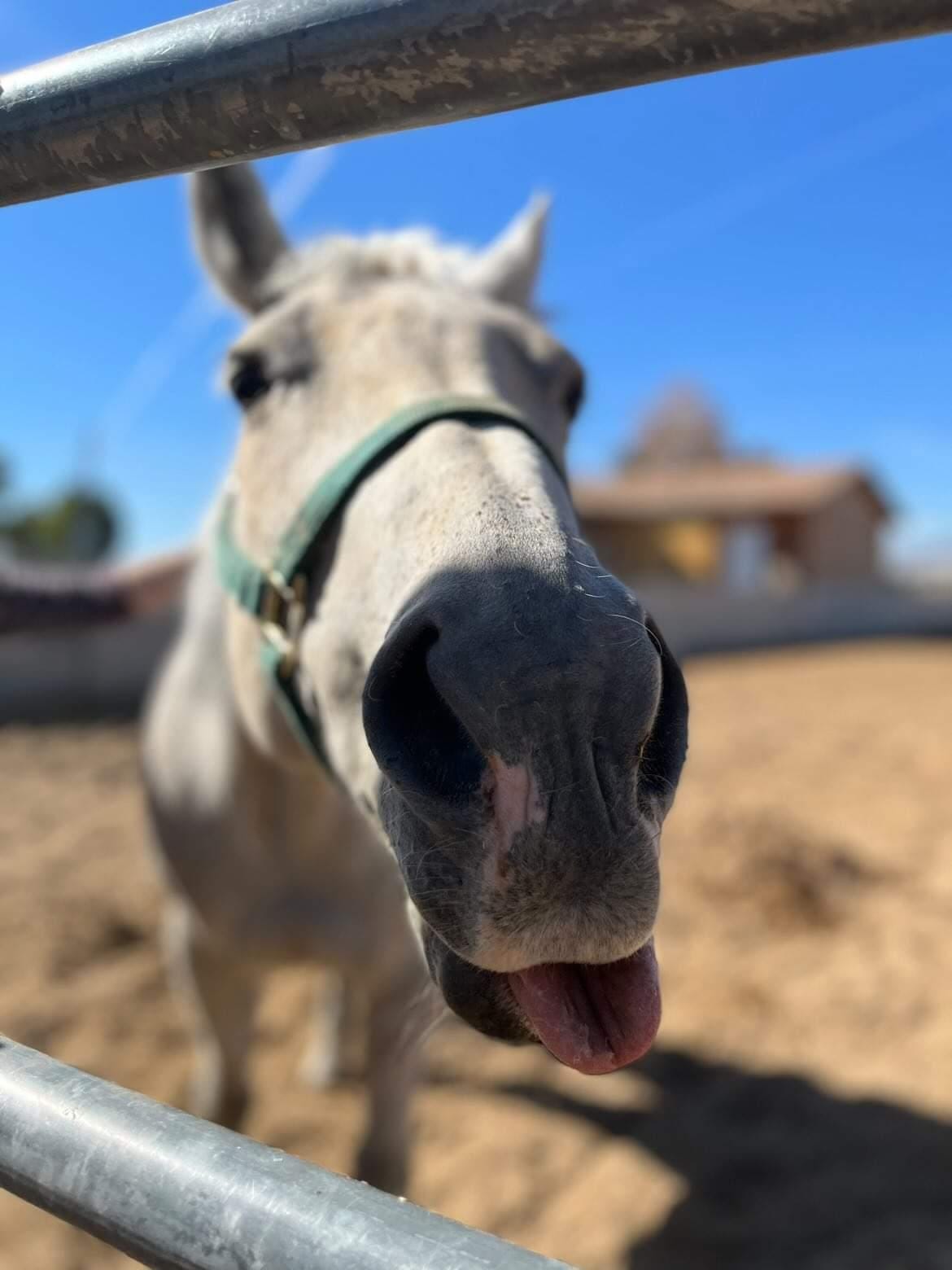
Today you climb the fence of the turnout and straddle it. Your boots used to be shiny black but they are coated with dust and held together with horse shit. Nickers is dusty white marble. Her blaze is gone. Her black fetlocks are the only evidence of her youth. She is sniffing the dirt, finding the perfect place to roll. She paws at the ground like a dog digging in its bed. She drops to her knees and her body collapses to the earth, sending clouds of dust into the air. She kicks her legs and grunts with pleasure at the sharp rocks that dig at the spots on her back her teeth can’t reach. You remind yourself to stay in this moment.
You wonder how you will recognize the passing of time when she’s all white. What comes after white?
Hana Jabr holds an MA in Literature from Weber State University. Her work has appeared in Juked, The Rumen, Thimble Lit Mag, and the print anthology Nightmares When I’m Cold. In October 2024, she was awarded second place in the Short Story Collection category of the Utah Original Writing Competition for her collection Breadcrumbs. A former educator, Hana is now a full-time writer based in Salt Lake City, where she is currently working on her debut novel.
This is so beautifully written and heartbreaking. I love it.