

I think I may be oppositional. No, I’m not!
In which Kerry discusses the value of a craft notebook
In 2021, I interviewed Hattie Crisell, the producer and host of the podcast In Writing with Hattie Crisell. In each episode, Hattie, a writer, journalist, and contributing editor at Grazia magazine, interviews a writer about their creative inspiration and practice, often in the place where they choose to write. It’s well worth a listen if you haven’t already, with interesting insights from a range of perspectives, including but not limited to those of novelists, poets, screenwriters, journalists, and filmmakers.
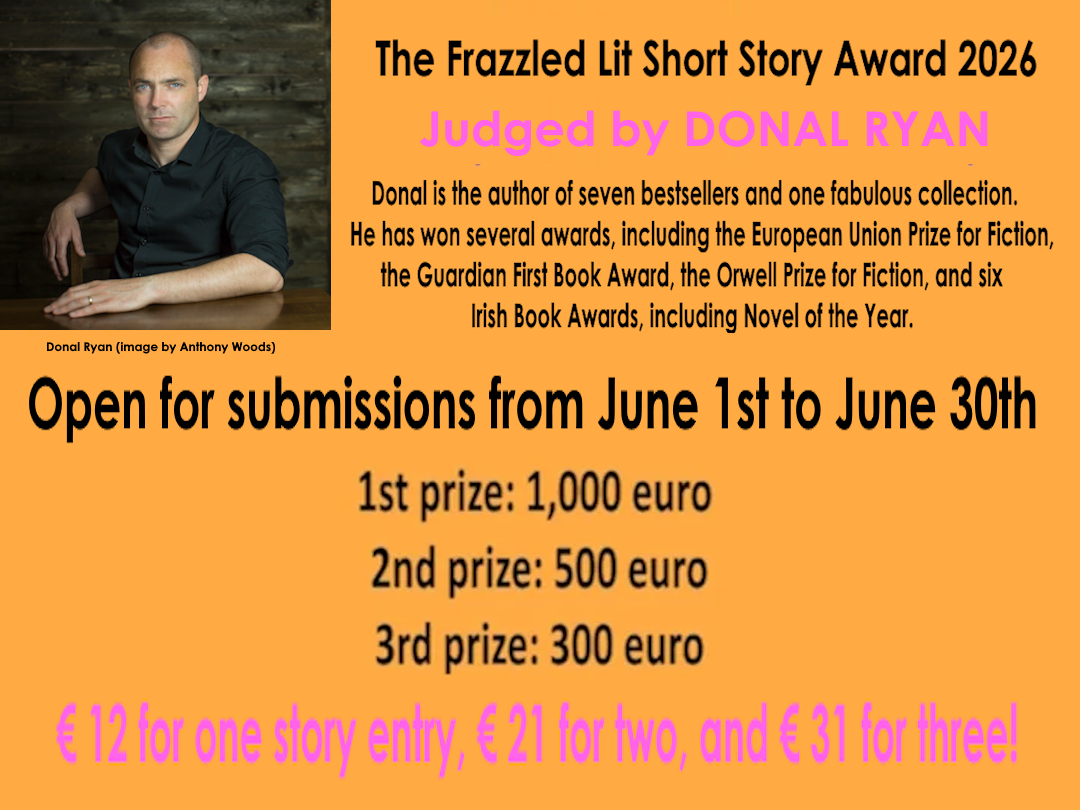
Listen to In Writing’s interview with multi-award-winning author Donal Ryan, judge of The Frazzled Lit Short Story Award 2026, here.
The biggest takeaway for me, as a new writer listening to the successful creatives featured on the podcast, was simple: There are no ‘rules’. Every writer has a unique early writing life, a writing space and routine that reflect their individual quirks, and their own professional journey to where they are now. It’s less about right or wrong and more about what works for you.
On the surface, this may appear liberating. But for someone with oppositional tendencies like me, this creates an infinite plethora of choices to make, even before beginning to not put them into practice. Does a clear desk really equate to a clear mind? Or should I surround myself with ‘stuff’ to inspire my writing process? Should I listen to The Idles or write in silence? Get up early to write or stay up late? Free write or edit as I go? Plan or pounce? See what I mean. For someone who is still trying to figure out who she is as a human, let alone her identity as a writer, the endless choices are exhausting, leaving little energy to not implement them when decisions are made.
The truth is, I spend infinitely more time thinking about writing (the how, where, why, and when) and angsting about not establishing positive creative practices than actually writing.
There is a glimmer of hope.
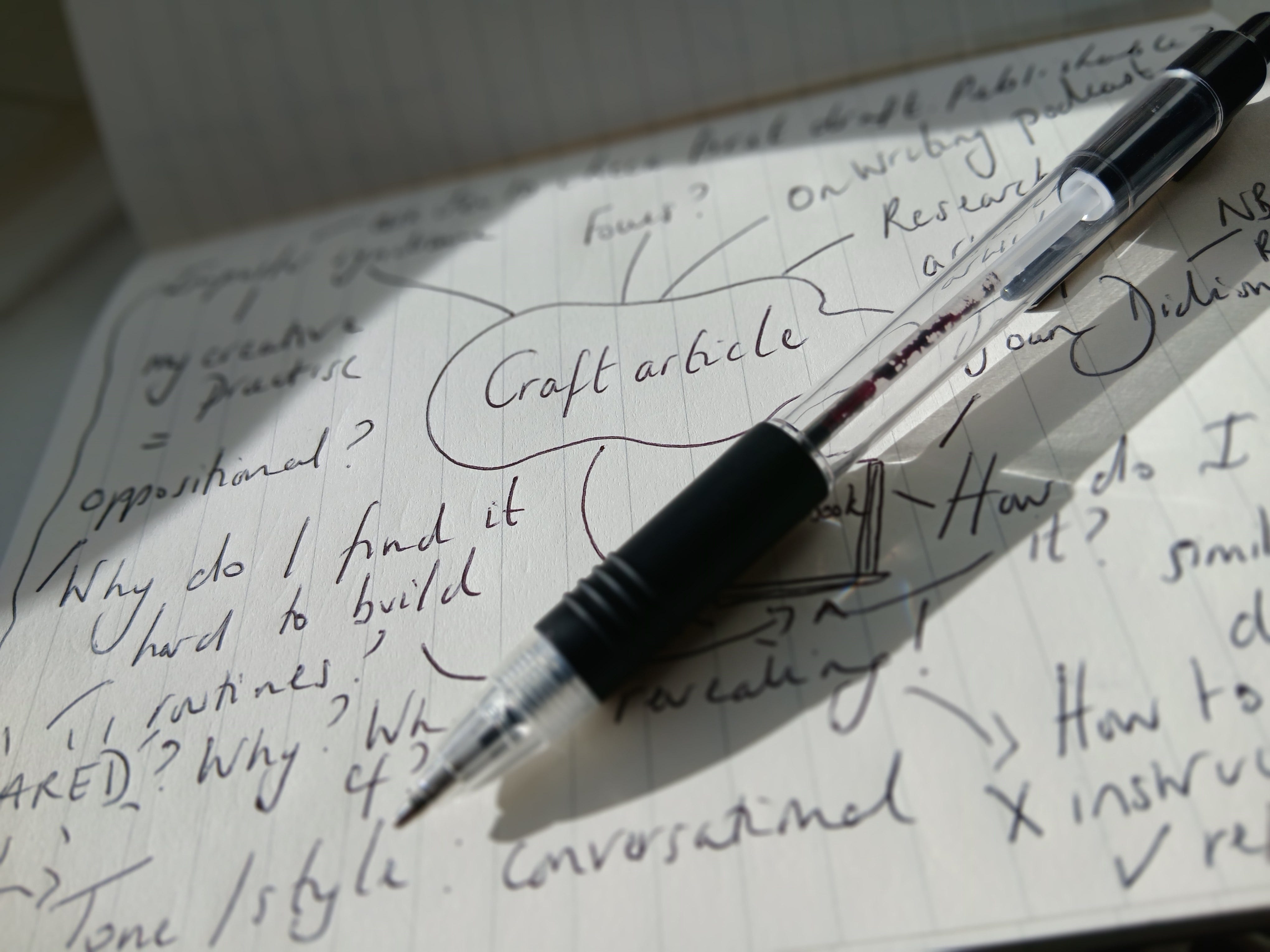
Recently, I read Joan Didion’s essay On Keeping a Notebook, and it struck me that jotting down ideas in a notebook is the only constant in my writing practice. It has evolved by happy accident rather than design: I love notebooks with arty covers and the feel of writing on thick paper, and as a perimenopausal woman, I constantly forget things. For these reasons and because I do not write in a notebook as a matter of routine (yes, you’ve guessed it, I forget), this practice has not fallen foul of my oppositional tilt.
I use a new page for each entry. My story ideas often take the shape of a spider diagram, with the initial seed of inspiration at the centre and arms connecting to keywords related to characters, setting, tense, key questions, and anything else that comes to mind. This usually starts in a simple form and evolves over time with bursts of inspiration in the middle of the night, during a shower, or after a glass of vino or two, often spilling over to the next few pages. I prefer to sit with an idea and let it percolate until it takes a recognisable form in my mind before I start writing.
If you’d asked me before I wrote this article, I’d have bet you 50 quid that that’s all I use the notebook for. Well, let’s just say I’d be in my overdraft.
It turns out I’ve used it far more variedly over the years than I give myself credit for. Inspired by reading, I’ve jotted down examples of experimental story structures, subversive dialogue, and novel tense shifting, among other techniques; outlined a mini essay on my thoughts on experimentation and hospitality to adhere to when I write; listed magpied words or phrases that have been used in innovative ways as reminders of the electric possibilities of language; and even scrawled a couple of pages of free writing, which I would swear I don’t do but aspire to.
In this way, my reflection on my use of a notebook echoes Didion’s. Our notebooks do, indeed, ‘give us away’ because ‘the common denominator...is always, transparently, shamelessly, the implacable “I.”’
Maybe I’m not oppositional. Maybe I’m just scared.
Scared to commit fully in case I fall short. Scared to embrace my creativity because writing leaves me feeling exposed. Scared that I will fall into the trap of writing for other people, when it’s so important for me to do this for myself and for any external success to be an added bonus rather than intrinsic motivation.
There’s a lot for me personally to unpack here, but one thing is clear.
Without realising it, my notebook is my safe space. It’s where I store sparks of stories, explore ideas without inhibition or doubt, experiment with new techniques, and work out what matters to me as a writer, using it as a guide. The pages are often messy, which is a positive sign; when I’m stressed, I tend to make things look tidy to find some kind of order or control. I don’t draw because I am rubbish at it, but there are sketches for when words didn’t come fast enough. There’s a freedom, honesty, and energy that sometimes gets stifled when I come to write, as I subconsciously start to frame my words in relation to outside constructs. It’s my first album, unfettered and raw; some of my best work in terms of its potential.
In Didion’s words, ‘your notebook will never help me, nor mine you’, but talking about craft and its relationship with the psychology of writing helps. It creates community and connection and hope—three things we need to preserve in the world right now.
Kerry, Assistant Editor
A departure from fiction in my new role as Assistant Editor at Frazzled Lit. Felt daunting, but got so much from writing it. Huge thanks to Jennifer for her encouragement. Hope you glean something useful, if only the excuse to buy a(nother) notebook (you hear me, fellow stationery lovers!).