

Listen to the author reading this story:
Joe Bernard butchered everything he sang with great relish. Dying foxes have produced sweeter notes. He’d do it with a tortured expression on his face, like he’d been stabbed in the gut with a screwdriver. The sheer torsion of his jaw was ferocious.
When he finished he’d smile at you sweetly, Father Christmas cheekbones pushed high.
“That was one in my own auld style,” he’d say, ever so softly.
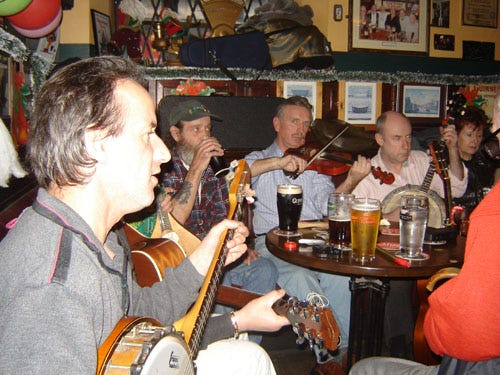
For years they put up with it at the session. People would go quiet when it was his go, they’d turn away slightly, they’d turn away slightly, making shy snark little comments or filter out for a make-believe cigarette. I always stayed, I always watched.
The pain of it. The anguish, that’s what I found impressive. You could feel it when he sang, like a death was occurring in front of you. Discordant, like he was fighting himself, the undulating notes flicking in and out of tune.
“He wasn’t always like this,” one of the elders said to me outside.
“What d’ya mean, like this?”
“With the banshee act I mean, torturing us all.”
“What was he like before?”
“I dunno… normal maybe.”
This carried on for a while. But one day, after too many Americans had complained to the bar, he was put out. I wasn’t involved with it, I’d been informed by a harsh whisper, they’d told him, he wasn’t welcome any longer.
I felt bad for him, I really did. But even I had to admit, it was a blessing for most. The session returned to normal, the standards were played. The musicians were talented and the singers tuneful. Life had eagerly returned to its usual flow. I was four pints deep, tapping a foot away to Susan Higgins’ speciality, Black is the Colour, when I felt a little scratch behind my ear. A tiny sensation. A glimmer.
Each night it felt stronger, stranger. It built and built and I tried my best to drink enough jars to ignore it completely but somehow it made it worse.
On a Thursday night in April, during a perfectly good rendition of Grace I slammed my hand onto my little table with a SNAP.
The regulars all turned to look at me, poor Marie-Anne who’d been warbling looked fit to cry. Which made me want to start bawling and all.
I fled out the front door with a thrown out cry.
“Sosososorry!”
Later, I lay down on my bedroom floor and stared up at the ceiling. Goran Ivanišević, my elderly cat, peered down at me, judging.
I knew what the problem was. And I knew, that I knew, what the problem was. Which made the ruminating easier.
None of the others felt like Joe Bernard did. The itching sensation had spread to my nose and I found myself scratching at it hopelessly. I was missing the honesty, the brutality. I could hear a false imitation of Joe’s whine creep into my own numbers, like I was being dragged flat and sharp by his absence.
I asked after him at the next session, my previous outburst explained away by a sick cousin marooned in Salford.
“Where’s our Joe Bernard these days?”
“He doesn’t come into town now. It was all a bit, well, awkward.”
“I’d like to go check up on him. Do you know where he lives?”
“Sure, me and Sandy used to practise up there. It’s the last house on Dwyer’s Lane, it has a red door. You can’t miss it,” a guilty pause emerged, “tell him I said hello so.”
I stalked my prey. I was feverish as I walked, pure adrenaline and fear. I didn’t even know what I wanted. A tune, I guessed. Just one song. One of his auld style ones. One to scrape the dirt off my soul and bully my ears into listening. I was craving it. I could taste the dog-weak tea from some dirty old mug already.
The house was a postcard from the outside. White painted pebbledash with red accents on all the windowsills and doors. A thatched roof, rare enough these days and some quaint little items leaning onto the walls. A wagon wheel, a pitchfork, a happy gnome.
I knew it’d be dark and damp inside, the windows were barely big enough to see out of.
He waved me in, a big smile crinkling his eyes and tattered skin.
“It’s yourself!”
“How’re ye getting on Joe?”
“Fine, fine, fine. Get in away from the cold. Baltic so it is.”
We were settled in his front room, unchanged since the 60s I expected. Mary gazed down at me from the wall, clasping her hands in anticipation. I was dealt a steaming mug, it warmed my hands nicely.
“How’s the session these days?” He asked.
“Oh, it’s grand. Not quite the same without you of course,” I smiled politely.
“Ah that’s alright. I knew it’d happen eventually,” he waved me away.
“Leslie and Sandy say hello.”
“I expect they do, ha.” He slurped his tea. “It’s fine, fine, really. I’m going round theirs tomorrow. It wasn’t personal, it was just about my style.” He nodded sagely.
“I meant to ask you about all that. About your style?”
“What about it?”
“Well, I guess what I want to know is, why do you sing like that?”
“What do you think I sing like?” A genuine question, no edge to it.
“It’s a bit of keening, a form of sean-nós. Like with the undulations, the flat notes, nasal bag pipe drones. It’s always, always in Irish, I can’t understand much, never paid any attention in school.” The words had fallen out of me quickly. I looked across at him gingerly, I didn’t want to offend him.
He nodded.
I carried on, encouraged. “But it’s out of tune, on purpose I think, it feels like something.” I sipped nervously, “you pour yourself into it.”
“Hmm. That’s about the sum of it I reckon. It’s not complicated, you have to feel the song, otherwise what’s the point?” He looked up at his Mary. “Why is a harder question. But I think what I tended to sing about, usually I mean, was death. You could say I was studying it.”
“Aye, so they’re dirges, like at a funeral?”
“I suppose so. That was the last bit I had to understand.”
“What last bit?”
“The last bit of the experience of life.”
“Death? And you understand it now?”
“No, no, no. Not yet, not truly,” he tapped his knuckle on the table, “but I have the impression of it. A glimpse into the dark.”
“And would you give us a tune now? Show me what you mean?” I bit my lip, the itching behind the ear was screaming at me now.
“I can. But I’ve changed again, I’m not just after death anymore.” He closed his eyes and set his shoulders back.
“Ah right, what is it now?”
He untucked one eye, winking out at me, “I’ll sing and you can try and figure it out.”
He began to sing and it was nothing like before, instead it started beautifully sweet, perfectly in tune. Major key, the undulations twinkled in and out like lapping swallows. He had an easy look about him, content. His brow was unwrinkled and his hands lay open on his knees.
There were a few verses and a chorus and I was enjoying it, but I was surprised. It was all honey and meadows, naive even.
He stopped with a slap to his knee after a rousing cheery chorus and produced a droning note. It had that nasal inflection, the key had changed. A mirror to the first, but warped. There was a minor tone to it now, an unseen shape skulking in the distance. The shape of it was no longer perfect and rounded.
The melody lines sped up slightly and became jagged. The time signature lost the run of itself. And then gradually, note by note, he started slipping in the flats and whines. Before long he’d started the aching gasping cries, his face screwed up and red, his jowls shaking and fists wrapped into claws. Then midway through a snarl he stopped, staying completely still.
It was like listening to a life cut short.
What had been so soft, gentle and perfect to start was transformed by the agony of loss crashing into it.
My eyes had glazed over and the irritation on my neck had gone. I breathed in deeply and shook my head. I looked up at him.
He was smiling at me so kindly.
“That was one in my own auld style,” he said quietly.
Liam Wallace is an Irish-English writer who’s spent most of the last decade in Croatia (with breaks in Scotland and Ireland), he now lives in Devon. He has worked in dive bars and pizzerias, chopped down Christmas trees, taught English to Grandmas and coded a lot of websites. ‘My Own Auld Style’ is the first of his stories to be published.