

Nowhere to hide - Donal Ryan on the short story
The final part of our competition judge's thoughts on short fiction
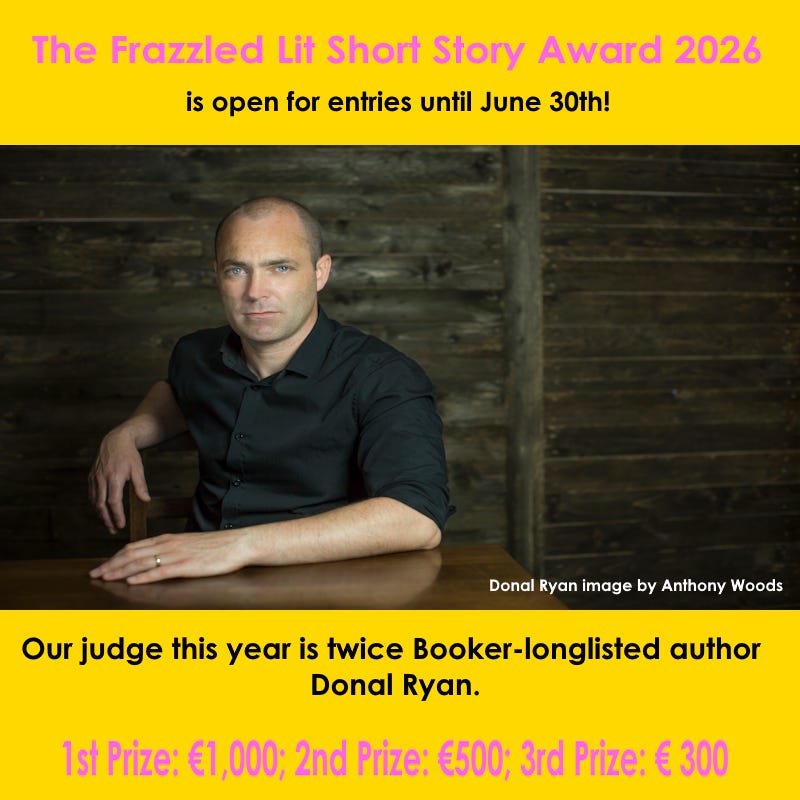
We’re almost down to wire in the Frazzled Lit Short Story Award 2026, and we’re loving the entries we’ve received so far. Keep them coming; we have plenty of room for more!
To inspire you, here is the final part of Donal’s thoughts on the short story, followed by my own!
Mike McCormack points out that the “wonderful accommodation” offered by the novel form is not offered by the short form. There’s nowhere to hide in short fiction; it’s a barren landscape and there are snipers on all sides. On the not-quite-other hand Mary Costello says any short story could be a novel and vice versa. So don’t be alarmed if your story starts to extend into novella or novel territory (there are no clear delineations anyway) but work towards a point where your story feels balanced and supple, to have a tensile strength and be robust; so that its various elements seem nicely weighted and right. Listen closely for this feeling: when you sense it you’ll know you’re near the story’s end.
Make sure your narrative makes sense. remove yourself from it as you re-read: “cast a cold eye upon it from above” as I was once advised. Stories occur in the interstices of existence, and of course the reader should be invited to look beyond the obvious, to infer and presume and guess, but opacity for its own sake is purposeless.
Don’t flog a dead horse. If it’s not coming, if it refuses to be tamed, if it keeps running away from you, leave it for a while. Regain your energy and tackle it again. If it starts to take over your life and still you can’t finish it, leave it unfinished. Writing should be important, but it should never be the most important thing.
Frank O’Connor said a short story should describe a moment of change in a person’s life, that it should be “a bright light falling on an action in such a way that the landscape of the person’s life assumes a new shape. Something happens – the iron bar is bent – and anything that happens that person afterwards, they never feel the same about again.” This is, I think, a perfect description of what we should aim for when we sit down to write stories
Wittgenstein pointed out that language as the vehicle of thought is the great paradox of our existence. That’s why writing stories can drive us mad. We can never fully describe anything, we can never tell the whole story. So our work will never be done.
Donal Ryan
I wrote a story last year that I really liked, and liked the concept of, but felt that it never quite worked. Some vital element was missing, or what was essential was obfuscated by unnecessary detail. Finding myself in need of a 1.5k word story for a submission opportunity, I dug it out of my archive and decided to rework it. In its original form, it was 2.2k words, and it was in the act of stripping it down to the length I needed that the real story began to emerge. I gave it the finishing touches last night, and can honestly say that it is now one of my favourite of my stories, and is perhaps one of my best. I share this to further illuminate one of Donal’s points; if a story isn’t working, step back from it, and give it some space. I have one short story that took me three years to finish. Every story has its time, and some need more time than others to reveal their truth. The worst thing we can do with any piece of writing, as Neil Hegarty recently told me, is to rush it.
Another point that really struck me was the bending of the bar, the moment of change in a story. After it, nothing is the same, and this is of course a classic structure for the short story. There are other forms of story too, though. The one I reworked this week, for example, doesn’t have a bend-the-bar moment, or if it’s there, it is very slight. The story is nuanced and subtle (or so I hope), and much is left to the reader to draw their own conclusions.
This brings me to another point: it’s not good enough that the story makes sense to me, it must also make sense to the reader. I can test this by casting a cold eye over it, as Donal says, and can further test the story by asking peer readers to read it. Their objective opinions might highlight parts of the story that require clarification.
I was reminded this week, as I crafted the new-ish story, that writing short fiction feels very much like chipping away at a slab of marble. The shape is in the stone, and as I tap bits off here and there, as I soften the corners and knock off the edges, it will reveal itself to me. I often don’t know what the shape actually is until I’m well into the process, so must trust my instincts to guide my hand. The closer to the end I get, the more I can mould and refine the shape to balance its elements. Every part must fit, everything in the story must serve the story.
In The Poetics, Aristotle stated that a story:
“… should have for its subject a single action, whole and complete, with a beginning, a middle, and an end. It will thus resemble a living organism in all its unity, and produce the pleasure proper to it.”
As in a living organism, the parts of a story should be interdependent, and function together in a unified manner to support the whole. There should be nothing superfluous, and each component should play an integral role.
My own definition of story runs as follows:
A story is a cohesive and unified narrative that brings a character, who is sufficiently motivated by need to overcome the challenges they face, to a potentially transformative resolution via conflict and a disruptive incident.
Refining it to a simpler form, we get:
Story transforms character via a disrupted narrative.
I’m not saying that this is a perfect definition, nor that it is definitive, but it may provide us with a starting point from which to understand the essence and nature of stories, why they work, and why in some cases they don’t.
The Frazzled Lit Short Story Award 2026 is open for submissions until June 30th, and we feel hugely honoured to have twice Booker-longlisted and multi award-winning Irish author Donal Ryan as this year’s judge.
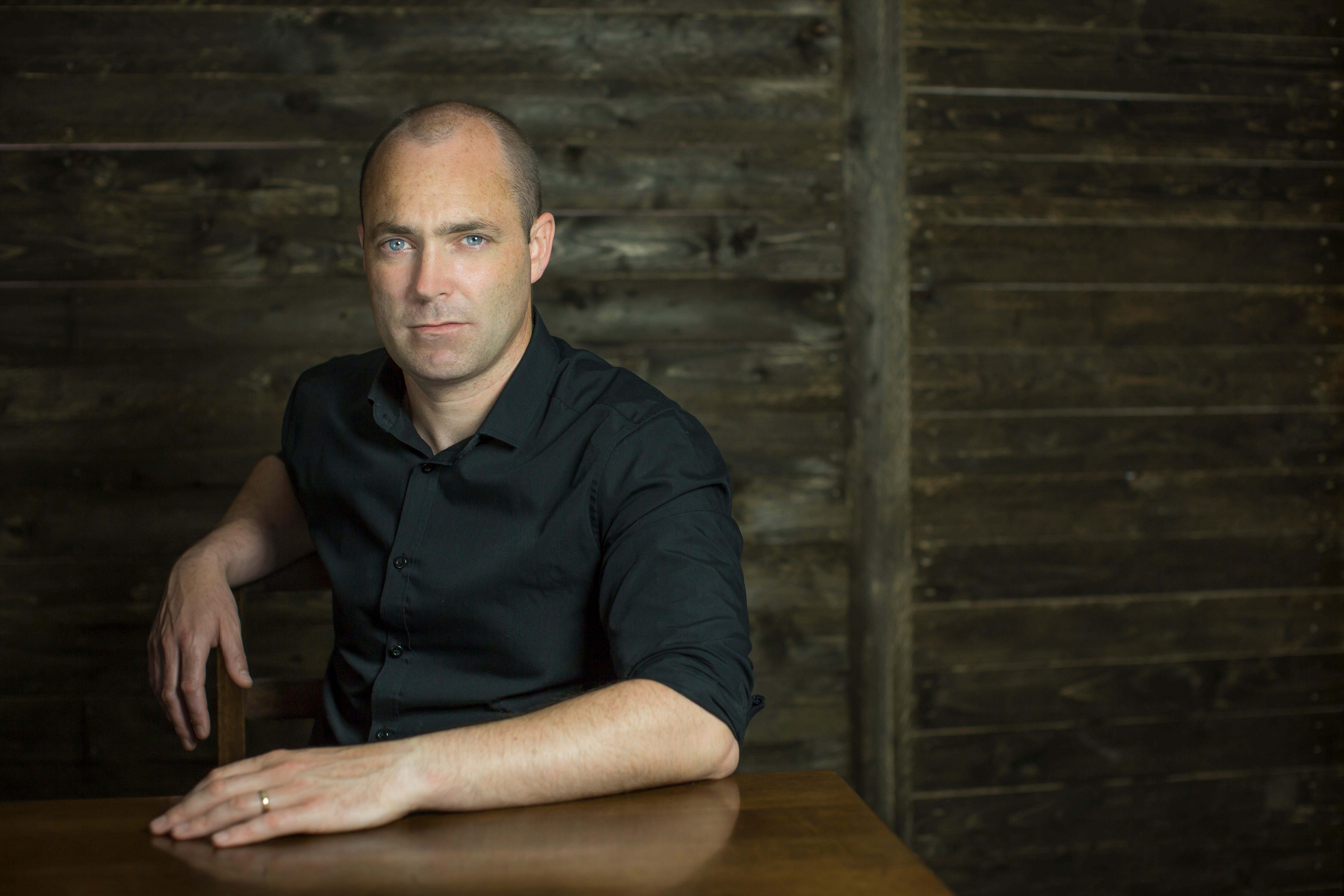
Donal Ryan has long been one of my literary heroes, and I’ve been most fortunate to meet him, and to have him read some of my work. His short fiction and novels are among the finest works ever produced by an Irish writer. He has published seven number-one bestsellers, plus a short story collection. He has won many awards for his work, including the European Union Prize for Literature, the Guardian First Book Award, and six Irish Book Awards, and has been shortlisted for many more, including the Costa Book Award and the Dublin International Literary Award.
He was longlisted for the Booker Prize in 2013 for his debut novel, The Spinning Heart, and in 2018, for his fourth novel, From A Low and Quiet Sea. The Spinning Heart was voted Irish Book of the Decade in 2016.
In 2021, Donal became the first Irish writer to be awarded the Jean Monnet Prize for European Literature. His most recent novel, Heart Be at Peace, won both Novel of the Year and Book of the Year at the Irish Book Awards, and was shortlisted for Novel of the Year at the Nero Book Awards. His work has been adapted for stage and screen and translated into over twenty languages.
Donal is an Associate Professor in the Creative Writing programme at the University of Limerick.
We can’t wait to see what you have for us!
Have you read Donal Ryan’s short story collection, A Slanting Of The Sun? If not, I most highly recommend it!
