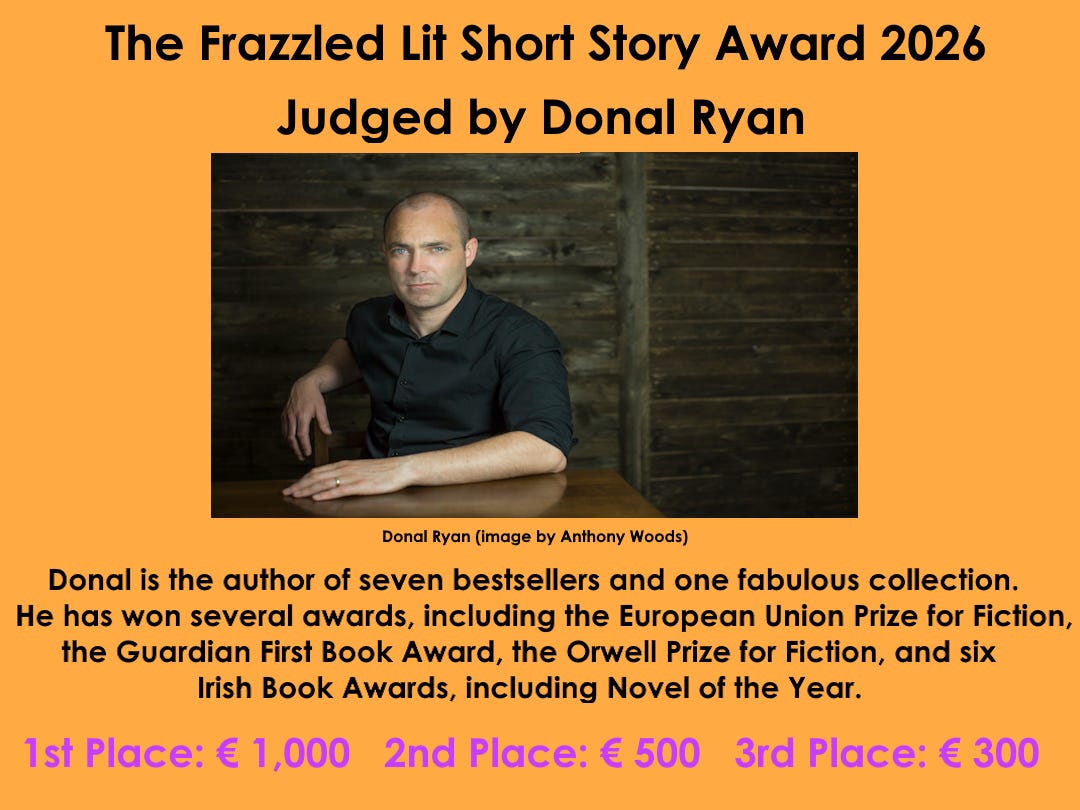
The Frazzled Lit Short Story Award 2026 opens for submissions on June 1st, and this is your chance to get your work before Donal Ryan, one of Ireland’s greatest writers, a twice Booker-longlisted author of seven bestsellers, winner of multiple national and international awards, and one of the nicest guys one could ever hope to meet!
In the lead-up, I’ll be writing some posts about short stories, and what it takes to get noticed in the queue. Today, I’ll share some thoughts on what you ought not to do in your submission.
Everyone has their own style and ideas for how a story should be written, and we want you to write your story in your own unique way, so what I offer below should be taken as no more than suggestions. None of these items will kill your story (apart from the word count one), and they won’t exclude you from the competition. Nor will they mean you won’t make it to the final, but avoiding these things will certainly help your chances.
Remember, we are your cheerleaders, and we’ll be reading the queue with a view to accepting, rather than rejecting, your story. We want you to succeed, and what this article is really about is putting you in the best posssible position to do so.
At the end of this post, I include links to a couple of earlier craft articles that might be of interest.
And it almost goes without saying, but I’m going to say it anyway:
We can’t wait to see what you have for us!
Our competition judge this year is Donal Ryan.
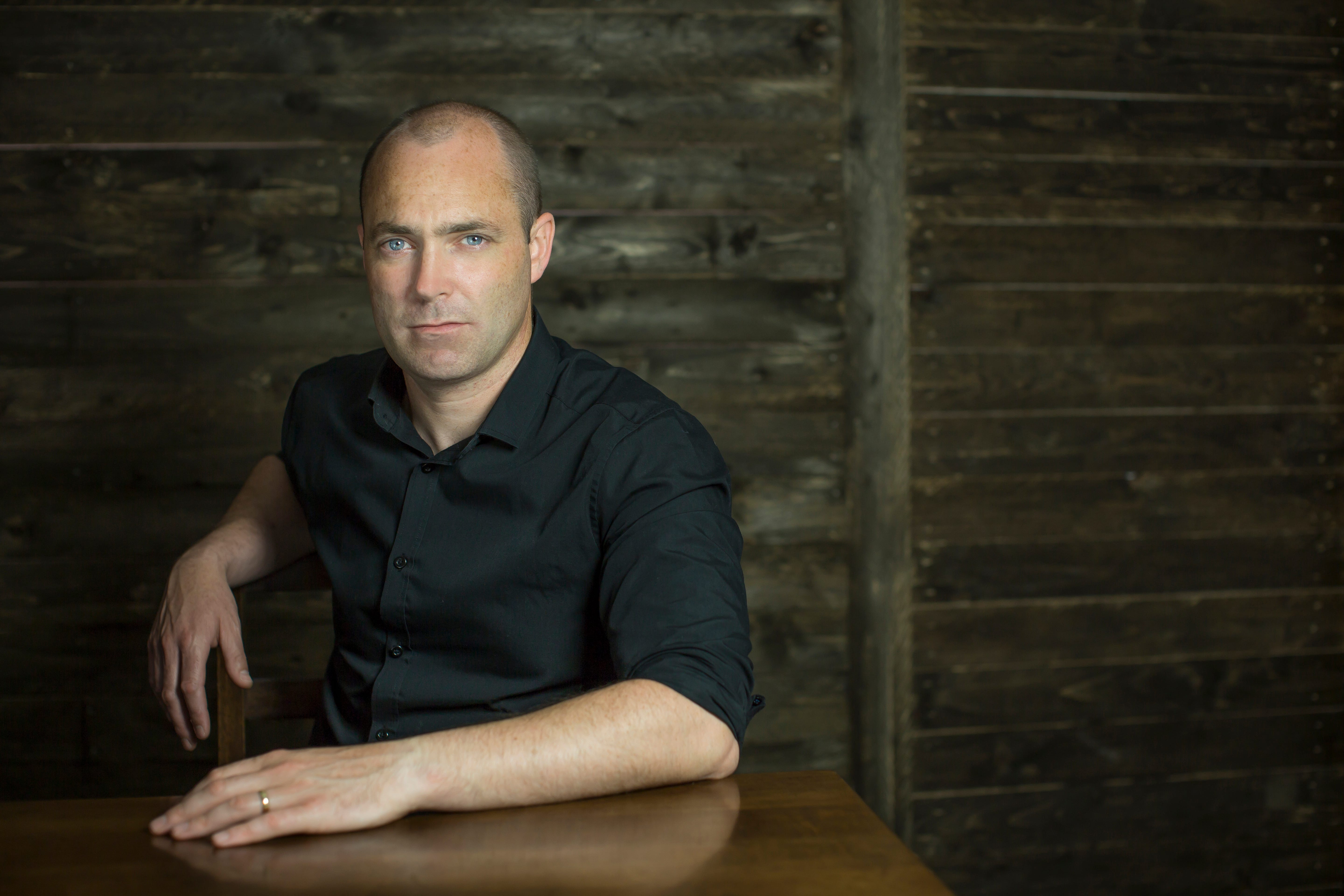
Donal has published seven number-one bestsellers, plus a short story collection. He has won many awards for his work, including the European Union Prize for Literature, the Guardian First Book Award and six Irish Book Awards, and has been shortlisted for many more, including the Costa Book Award and the Dublin International Literary Award.
He was longlisted for the Booker Prize in 2013 for his debut novel, The Spinning Heart, and in 2018, for his fourth novel, From A Low and Quiet Sea. The Spinning Heart was voted Irish Book of the Decade in 2016.
In 2021 Donal became the first Irish writer to be awarded the Jean Monnet Prize for European Literature. His most recent novel, Heart Be at Peace, won both Novel of the Year and Book of the Year at the Irish Book Awards, and was shortlisted for Novel of the Year at the Nero Book Awards. His work has been adapted for stage and screen and translated into over twenty languages.
Donal is an Associate Professor in the Creative Writing programme at the University of Limerick.
1. Leading with rich (and pointless) descriptions
“The trees in the garden swayed in the stiff breeze under a tumultuous sky, where clouds barrelled playfully along, morphing into dragon and cartoon character shapes. In between them, the sky was so blue that it was turning to white along the horizon, where the mountains stood like teeth gritted against a cruel and unforgiving world. Gazing from her top floor balcony at them, Deirdre brushed her long blonde hair, one hundred strokes, then looked into the garden where bees buzzed gaily among the wildflowers she had sown late last year. The lavender, rich and heavy with scent, brought her mind to other mountains, snowcapped and forbidding, and to another garden where the shrubbery had been shaped into human-like figures, as if its owner had wished to populate his world with…”
That’s not entirely awful (I just whipped it up, by way of illustration), but it needs to get to the point. What’s this story about? The first line, at least the first paragraph, can encapsulate the entire tale. Get us into the story, situate us, let us know what’s happening. Keep the prose active, especially at the start.
Having said that, a story opening like this can work if the details are relevant to the tale and the character. Does the garden, the sky, the view, really matter at this point? It sets the scene, but it would be better to start with the character rather than the setting.
2. Opening with dialogue
“‘Have you come far,’ Seamus asked.
‘Far enough,’ I said.
‘You’ll want something to eat, then.’
‘No, I’m grand.’”
I’m not saying that opening with a passage of dialogue never works, but unless it’s done with great skill, I feel it’s best avoided. I don’t know who the characters are, I don’t care about them, and now the writer has to get me to care when both she and I are on the back foot.
What I’m really saying here is to not overdo it. Opening with a single line line of dialogue can work well, because it raises the reader’s curiosity. Two lines would be stretching it. Three? Well, now I’m lost!
Related to this are stories with too much, or mostly, dialogue. Again, unless it’s done with great skill, it’s a hard act to carry off.
3. Filtering
Using phrases like ‘He saw…’, ‘She thought…’, ‘He heard…’, ‘They noticed…’, all create psychic distance, and put a layer between us and the characters. They should be used sparingly, if at all. Mostly, they’re easy to eliminate.
For example:
‘She thought he would probably text her.’
becomes
‘He would text her. He had to.’
And:
‘She heard a rooster crowing in the distance.
becomes
‘In the distance, a rooster crowed.’
You can get more mileage by removing the filters. And by doing so, you bring the reader closer to the character and the action.
4. Lack of clarity
Subtlety is great, but don’t be so subtle as to confuse us. Ground us in the story. You might think we know what’s going on, but are you entirely sure?
This doesn’t mean you have to spell everything out (in fact, don’t do that), but you need to give us enough hints so that we can work out what’s happening, and to whom.
5. Blowing the ending
End well. A poor ending can ruin the experience of reading the story. We’ve stuck with it all the way, so reward us.
Call back to something at the start of the story, to give it a circular feel.
An open ending is fine.
A flat arc is fine too, but better if it ends with us knowing something new about the character.
6. Hammering home the theme
You might have a clear idea of what the theme is, but don’t tell us. Let us discover or intuit it, or decide for ourselves what the theme is. We might take an entirely different meaning from the story than you intended.
Mostly what we want is a feeling of what the story is about. A sense of it, rather than coming away from it and saying that the story was about grief, or hate, or revenge or whatever.
In most cases we would advise forgetting about theme. Just tell a good tale, and keep us engaged. If there’s meaning there, we will find it.
7. Poor presentation
Spelling errors, little attention to punctuation, sloppy presentation, all show a writer who doesn’t really care for their work. And if they don’t then why should we?
Having said that, we won’t reject a story purely on the basis of poor presentation or sloppy spelling. We understand and accept that not all writers are well-versed in how to present a story, and that spelling errors are unintentional, and may be (for example) due to a writer’s dylexia. So we’ll deal with poor presentation if we have to, and all I’m really trying to do here is to encourage you to read the guidelines and take as much care with your manuscript as you are able.
8. Ignoring the word count rule
Stories under 750 words or over 2,000 words will get an instant rejection. In submissions to issues of Frazzled Lit, we can be more flexible, but this is a competition, and there are rules. It wouldn’t be fair for us to give you a pass on blowing the word count when other writers have worked hard to stick to it.