

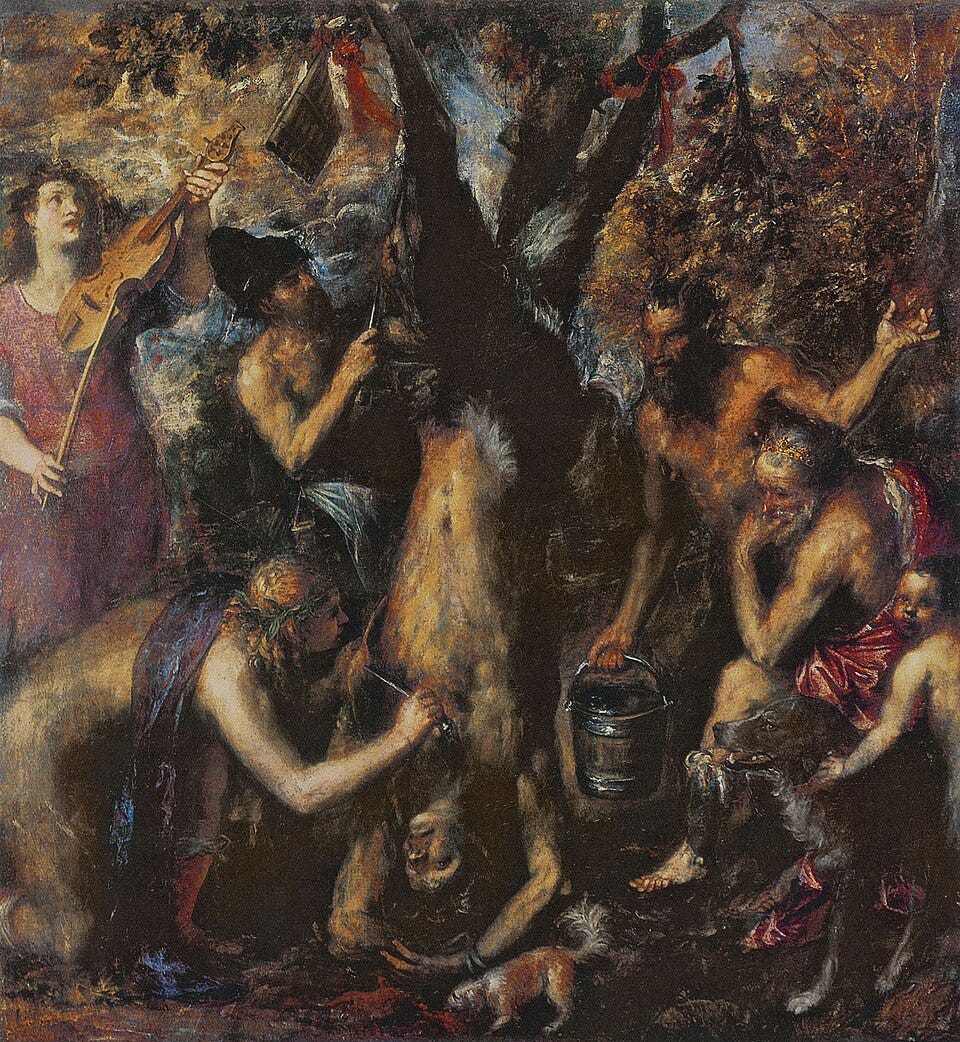
Once more, the sun was bloodletting. I was unable to break my own reproduction of The Flaying of Marsyas into a diptych, I threw away the brush, the charcoal, the razor and the soap, and surrendered by hanging the finished work; when a tortoise with no eyes entered the gallery. It moved between the works, stretched its neck toward the frames, picking them with its beak, and breathed all over the hollow canvases. The creature reached the last one, stared at me with protracted nostrils, and then turned away and marched laboriously toward the setting sun. While I pondered over my complete lack of bewilderment, I noticed that the works it touched were glowing in the night with these words:
The artist thrust the sharper end of his brush into his eyes, thus ridding the world of his chromatic dysentery.
The prying eyes are in lamentation, the foreshortened erection is discovered from under the sheets.
Above the heap of his sacrificed foreskins, the old man is resting with a knife in his left hand.
I was furious over the desecration of my aesthetic cemetery, were these words descriptions, interpretations, or translations of works already translated to the last breathing element? The creature must be the demon of interpretation or aphorism, I thought. A decrepit, vegetative spirit whose heaviness has increased with age.
The tortoise is perhaps a muse, I told myself after considering the words more carefully, or even the Angel of the Annunciation, whose journey down here and earthly form is scaled and slow and exceedingly real. How else could it know from its twice removed sphere about the obstinate line, the shrieking colors and the desertion of the night? From the first sentence I understood that the ear cutting, like all minor suicides, is a very deliberate and ridiculous invocation to a ponderously absent muse. I have been inclined myself to those minor suicides, at one period I used to throw six eggs every morning against the wall with a ridiculously slow swing before taking the brush, I realized after the visitation of the tortoise that only the constrained consciousness of the gesture was transporting me to some higher category of affirmative madness.
In the past, the patroned master transfigured popes and prostitutes into saints and goddesses, but he also clothed the divine in human garments. The artist afterward, starving and independent, had to solidify the fleeting idea of his art by the scornful transfer of reality. Today, when inexpensive pigments and endless mirroring prevent the modern performer from embracing his enlarged ego, his marginal livelihood is tied up to his histrionics. Poets are fully trained academics, the composer teaches and conducts what he should be forgetting, painters become museum attendants, and their delicate sense is forever shattered by centuries of grave perusal, the thick layers of admiration and the arrears of unwounded beauty. Most people in fact become artists because they are looking for a license to be evil, something between an excuse and a blessing for cruelty; therein lies the legendary artistic cowardice, and their absurd and erratic audacity. Nevertheless, with all the detailed catalogues, the tedious expositions and retrospectives, the tons and acres of dissected art, the first flame was blown from my heart, and I became sick from constantly facing myself and pretending to be an artist just because I couldn’t help out-threading myself. So I decided to work as a curator, restorer, director, critic, judge, and, until the tortoise came, sole admirer in my own gallery of obvious and dry counterfeits. I recreated some revealing paintings from the past, and then abstracted the colors to their essential disappearance.
Marsyas had a very personal resonance, that fatefully flayed failure prompted me to put all my works under his self-satyriasic sign. To succeed in representing the representation of a mythological loser, was it a justification of my life or the perverse and tactical retreat against the necessity of immediate expression? I recognized myself in the poor creature’s attempt to imitate the divine obstinately through himself. Even if the world itself became for me the result of bad imitation, art remained the necessary tension toward the opposite by virtue of the sameness ardor.
I felt sick by this sudden and complete transparency to myself, and hollow from the cramming of the metamorphosed, thickly hided Tiresias between my understanding and my will. With its brazen head, its cavernous and chiseled motion, the creature traded simply its blindness for an immediate all sightedness and was luring me to leap from the extreme negativity to a made-up Absolute. I tried to resist the artifice of an abstract ascent, flipping the opposite sides is easier and more common than walking through their endless and thin connecting thread.
During my beginnings I couldn’t get over the conviction that the significant movement of painting died with Cézanne, and I thought that correcting nature with a dilettante, slightly disgusted stance, was the only way for an artist to properly inhale this old world of new forms. I created etchings to distort ancient legends. I made collages of historical noses, I clipped some ears from some portraits and painted translucent films over them, my idea was that our imperfection lay in the impossibility of the hearing to shut itself up, like any other outward sense. I have also designed a series of protruding front teeth in death masks, and an installation called West-östlicher Diwan, which was a juxtaposition of two toilet seats, a western in plastic and an eastern in marble, the first with a thick roll of paper and the other with a bucket of murky water. It was acclaimed for a short time for its cultural commentary, and then dismissed as unsubstantiated and frivolously burdening. I guess that anyone can relieve himself however he wants nowadays. The unity of excrement must finally reconcile two different humanities.
Finally, after a disappointing journey to the north where I was looking for darkness and a shelter to my withering melancholia, guided by an intellectual, chiropteran muse; I came back to this sunny haven of my infancy, to force myself into believing again in the blunt and native colors, but everything is shut now in a still and endless light. I slept worse than usual that night. The abstract tortures of self-consciousness paralyzed my mind, and my members were torn by the convulsive ties of transparency. Know Thyself was in fact my sentence. When I woke up, inspired, I scribbled in my left hand the rites according to which I could ultimately flay the finished work.
I had to beware the mornings, but the revelation was in fact the patient outcome of a cloyless consciousness, filled and outweighed by a hard miracle. I impaled the canvases, except for The Flaying of Marsyas. Resisting the urge to burn them, I gnawed through the heap like a rat. I ruminated at last my ancient etchings about the line and the color with an indescribable elation of mind. I absorbed four packs of unfiltered cigarettes to tow the craven dusk. One can channel clinical depression through death, humanity and pills, but only smoking will outline the dream and play a modern trick on the cloudless day.
Once more, the sun was bloodletting. The crepuscular being reappeared, it must feed upon my fancy, I thought. I was ready to break the completed canvas and stab its allegorical heart, the prosy thickness finally gushed out:
‘Once upon a time, the child could reach stretches of boredom that the intellect-stricken artist only forced himself to dream about. Two schools were in his village, he went to the new one, where he learned the alphabet in a new book. Only he didn’t care for dry words and dead sentences, and his heart longed after the pictures. The figures in the modern book were abnormally elongated in unbroken surfaces, some were distorted and rigidly bidimensional, others were too abstract and infantile for his discerning fancy. But those in the old school had an old book, and it was filled with strong drawings and honest paintings. Every evening, the child would go running down the hill to his friend’s house, who was still learning in the old school, for he was too big and stupid to be moved to the new one; the child grabbed his friend’s book with the fancy beating heavenly marches in his breast, he opened it, and was lost for an hour in his crepuscular admiration: clear streams, girls bright and laughing, heather fields and giant oak trees, autumn covered roads and gables. He had never seen such landscapes before, they lived only within the rough and withering leaves of the book, but he knew they existed elsewhere and he framed his dreams around them. Nature in the ancient book was a colored cycle: winter dark and white, spring a generous green, summer blue and clear, fall a tender screen. One day he went as usual to the friend’s house and his father told him he wasn’t there, that he went away for a few days to visit some relatives further down the hill. The child turned around and was about to leave when a very strong sadness seized him, and an overwhelming desire to find something that night around which to dream made him bold, he told himself that a quick view will sustain him for days, he knocked again and told the man to let him in for a moment to see the book. As soon as he ushered the child in, the heavy-set man flew with quick strides toward his son’s school bag and stuck it on top of the high cupboard. He presented an empty bag to the confused child and bade him look for it up there. After a few seconds, the child felt eager again, and was happy to climb and claim the prize, but the man lifted him up, and the child searched with trembling hands through rolls and rolls of dusty papers, while the man kept stroking his feeble skin all over. He suddenly planted a breathing orifice between the child’s thighs and inhaled with a dying intensity. The child grabbed something and told the man that he had found the book. The man put him down, and with revulsed eyes rearranged his trousers. The child ran away and threw the pungent papers in the mud. As he grew into tastelessness, aesthetically weaned and circumcised, he hankered only after the paradoxical. He became interested in the etchings of old masters, even if he knew and resented the fact that they were just the premises of the fully ripe works. Trying to stretch their promises toward the opposite, he imagined them as the murder of the colorful, and not its imminent deliverance. That’s when the intellectual tendency seized him, and he learned to admire henceforward with a distorting logic. One morning, he was reading in an encyclopedia, and discovered much more than the old and the new pictures, but he felt neither joy nor disheartening. The illustrations were in a gray softened by time, and he pondered over the fateful covering of the paints. Naturally, the figures already uncovered were stripped away, ink from the downward leaves cankered the syphilitic Origin of the World and Liberty’s hypocritical breast, while a fossilized fly fastened Endymion’s dubious slumber. He kept turning the pages with his spit until he saw as in a dream: the frescoed figure, gilded in cerulean drapery, seated, sandalled and high sceptered between six proud rams, The Good Shepherd of Ravenna. The growing child felt the fire burning inside his loins and made furtive movements in order to spread the sacred colors, but he slipped and fell into repetition. From the ardor of his convulsed frame, blood and milk trickled down his feet. He grabbed a paper knife, but the blade that cut the ear and the spurious foreskin, melted, and failed to reach the true heart.’
Cainhurst is from Algeria, once the land of Augustin and Donatus Magnus, he holds a PhD in French literature and enjoys writing in English.