

The point of a story is the story - Donal Ryan on the short story
Further wisdom on short-form fiction from our competition judge
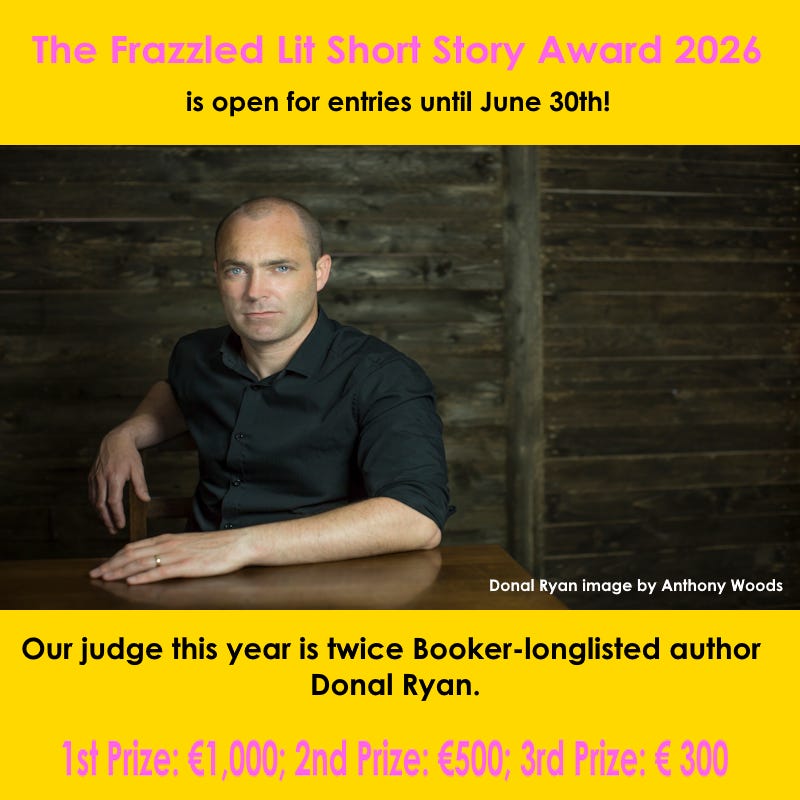
Today, I share another excerpt from Donal Ryan’s thoughts on the nature of the short story, followed by my own musings on the topic. Donal is our competition judge this year, and we feel very honoured to have him.
That’s enough of a preamble; let’s get into it!
“The point of a story is the story.
The one thing writers can’t be excused for is causing boredom in their readers. For me the best short stories are tight, complete and satisfying. There’s no crushing weight of superfluous detail, no philosophical meanderings, the story is told cleanly and vividly in as economical a way as possible. It’s important for me as a reader to believe without question that each thing that’s said could be said no better way.
I recently read guidelines given by a media outlet for short story submissions. The ending, they said, should tie neatly in with the beginning. This seemed a bit prescriptive to me; my inner creative diva bristled. But thinking about it, it’s not a bad piece of advice. People should feel somehow satisfied at the end of a short story; something should have been sorted out, or ended, or explained, or illuminated in some way.
Short stories are hard to write, but they should not be hard to read, regardless of the subject matter. The pleasure, or the intensity of emotion evoked in the reader should be directly proportional to the effort given to the story’s creation. I often think of a short story as a meal: I want to enjoy each piece of it, to feel satisfied at its end, I want it to be memorable, and I want to be eager to repeat the experience.
…
Frank O’Connor said a short story should describe a moment of change in a person’s life, that it should be ‘a bright light falling on an action in such a way that the landscape of the person’s life assumes a new shape. Something happens – the iron bar is bent – and anything that happens that person afterwards, they never feel the same about again.’
This is, I think, a perfect description of what we should aim for when we sit down to write stories”
Donal Ryan
We all know what a story is, right? We tell many of them as we go through an average day, stories like:
“You’ll never guess who I met at the supermarket, only Joni who used live in No. 27, and she was with that fella from the butchers on the corner of Main Street, you know the one I mean, he had that nasty dog that hated children, and now Joni is married to him, and I’m there in the supermarket talking to her when…”
Stories are a part of our shared humanity, our cultures, the basis of our social connections. Stories are how we make sense of what can sometimes be a crazy, maddening world. This happened, then this happened, then another thing and another, until - rushing breathlessly to the end - this new thing happened that we didn’t expect, a transformative event that upsets everything. This event may also make sense of what went before, thus leaving us with a contented feeling because we have formed a shape and a pattern of it all, and our brains like nothing better than patterns. In making one, the tale fits neatly into our understanding of the universe.
Some stories may be open-ended and unresolved, of course, leaving an unanswered question, but these can be even more powerful because after the tale has been woven, it still exists within us as an incomplete narrative.
We are left to wonder, and wonderment is, I think, the whole point.
I’ve often said that the first job of a writer is to entertain, and to do this, we must engage our readers. There are a number of ways to do this, such as clever use of language, clarity and precision of prose, creating a mystery or posing questions that engage the reader’s curiosity, thus encouraging them to read on in the hopes of finding a solution. These, and other devices, invite the reader into the story, and make them a part of the narrative world.
At some point in a story, we will want to reach a pivot point, the bending of the iron bar. Something changes in the character and/or the narrative world; something new is learned, a realisation occurs, an event horizon is crossed that can’t be uncrossed. This is the tipping point, the ‘but THEN…’ of the story that leads us to the ‘… until FINALLY…’ of the story, which is the resumption of the narrative continuum, though perhaps in a different form.
So much could be said about short-form fiction, but the main thing today is that, like the man says, writing short stories is hard, while reading them should be entertaining and effortless. In the first instance, what I’m really doing when I write a short story is entertaining myself, because if I’m not enjoying the tale or the process of creating it then the reader probably won’t enjoy reading it. I need to tell myself the story first, and maybe during the editing phase, I will employ some of the devices that can increase reader engagement, if I haven’t already instinctively included them in early drafts.
The most important thing for me as a writer is to create work that makes me laugh and cry and feel some sort of something for my characters and the world I’ve created for them.
If my story can do that for me, I’ll just bet it can do it for you!
The Frazzled Lit Short Story Award 2026 is open for submissions until June 30th, and we feel hugely honoured to have twice Booker-longlisted and multi award-winning Irish author Donal Ryan as this year’s judge.
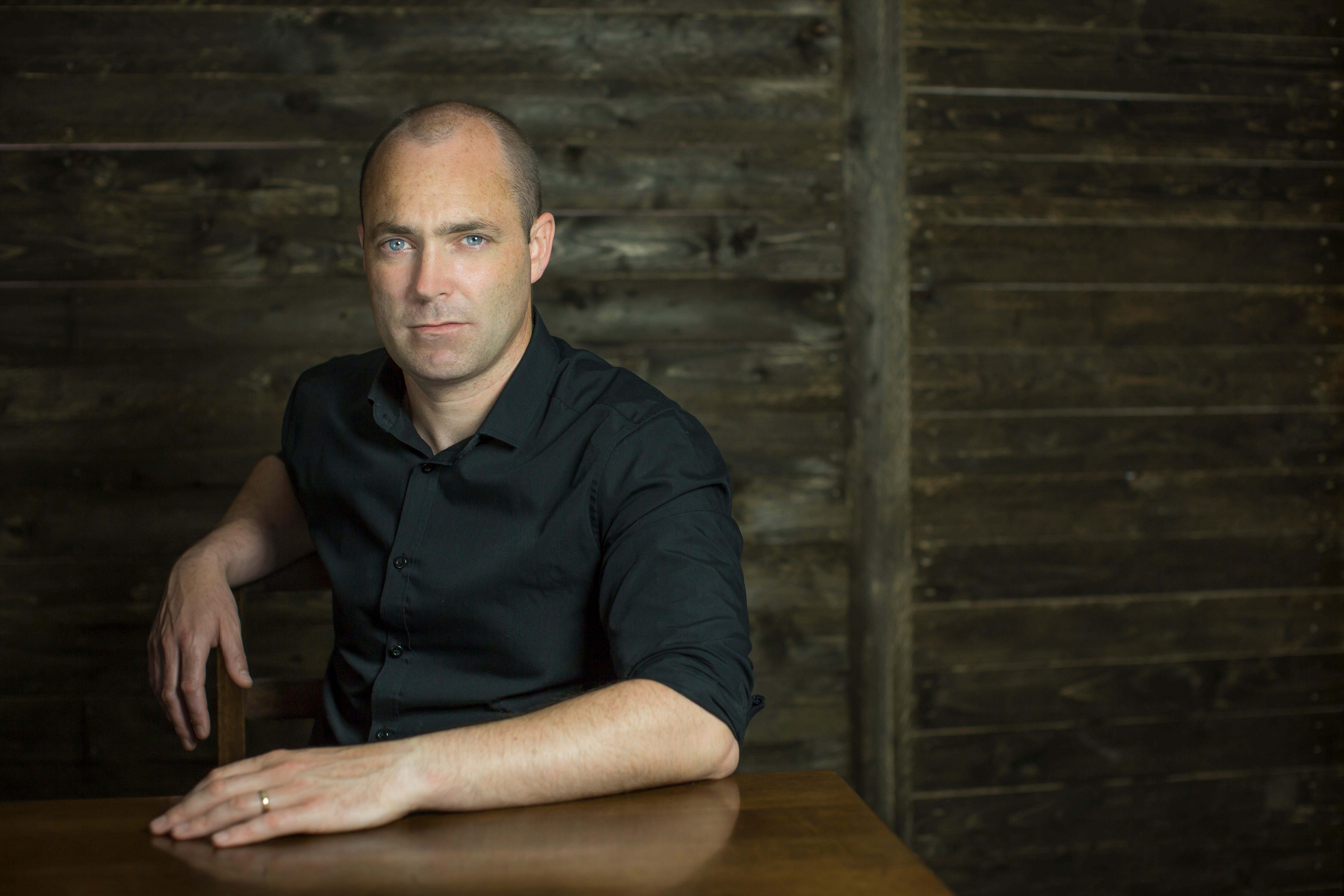
Donal Ryan has long been one of my literary heroes, and I’ve been most fortunate to meet him, and to have him read some of my work. His short fiction and novels are among the finest works ever produced by an Irish writer. He has published seven number-one bestsellers, plus a short story collection. He has won many awards for his work, including the European Union Prize for Literature, the Guardian First Book Award, and six Irish Book Awards, and has been shortlisted for many more, including the Costa Book Award and the Dublin International Literary Award.
He was longlisted for the Booker Prize in 2013 for his debut novel, The Spinning Heart, and in 2018, for his fourth novel, From A Low and Quiet Sea. The Spinning Heart was voted Irish Book of the Decade in 2016.
In 2021, Donal became the first Irish writer to be awarded the Jean Monnet Prize for European Literature. His most recent novel, Heart Be at Peace, won both Novel of the Year and Book of the Year at the Irish Book Awards, and was shortlisted for Novel of the Year at the Nero Book Awards. His work has been adapted for stage and screen and translated into over twenty languages.
Donal is an Associate Professor in the Creative Writing programme at the University of Limerick.
We can’t wait to see what you have for us!
Nice. That the ending should echo the beginning made me smile. I started the first story in my short story collection Saltburn with a boy watching a documentary on Chernobyl. I had no idea where it was going, the story. But, short stories are logical. So of course this boy had to go on, become an orphan, get taken in by an alchemist, go to uni and study science, get a job in a nuclear power plant, which, of course, melts down. Like Chernobyl. It’s not planned. I often start with a character, a situation, and then let itself work itself out from there. My collection, Saltburn, is currently half price for Pride - https://renardpress.com/books/saltburn/